
- 1 What Is Predictive AI?
- 2 Why Enterprises Are Adopting Predictive AI Support
- 3 How AI Upgrades Software Maintenance Operations
- 4 How Does AI Enable the Shift From Reactive to Predictive Maintenance?
- 5 Areas Software Maintenance Benefits Most From AI
- 6 SystechCorp ’s Approach to Predictive Maintenance
- 7 How AI Capabilities Future-Proof Modern Software Systems
Nowadays, most high-tech-driven businesses demand reliability, real-time performance, and continuous improvement. However, the most conventional way that organizations still depend on reactive support models, responding only after incidents occur. When crucial business infrastructure scales, this approach becomes costly, inefficient, and risky, particularly when downtime instantly affects revenue and CX (Customer Experience).
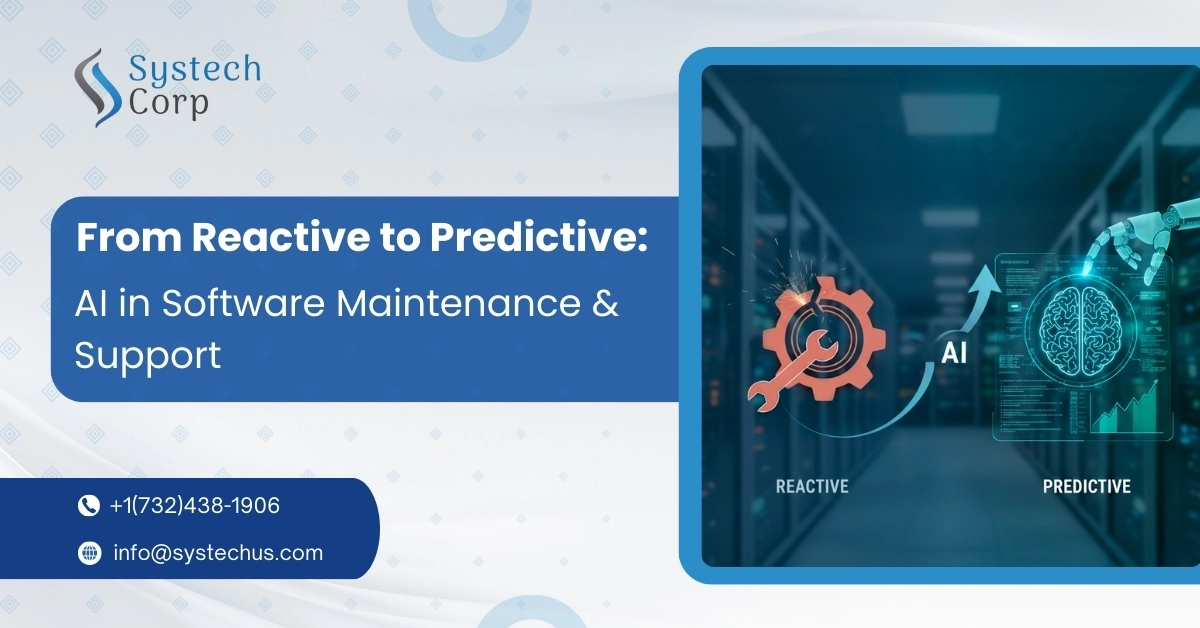
The global trend toward increased automation and intelligent operations is changing how organizations manage their application environments. AI-powered monitoring, machine learning-based diagnostics, and predictive intervention models are helping organizations transition from an after-the-fact support model to one that emphasizes proactive and preventive maintenance. Systech Corporation has taken a leadership position in this evolution by providing organizations with intelligent, automated maintenance frameworks that enable them to modernize their application environments, significantly reduce failures, and enhance the longevity of their applications.
In this article, we break down how organizations are using AI-driven software maintenance to eliminate technical debt, reduce support overhead, and build systems capable of self-diagnosing and self-healing in real time.
What Is Predictive AI?
The ability to analyze how a system behaves over time, identify anomalous behavior, and predict when it is most likely to fail, through the application of machine learning techniques and Predictive AI, is referred to as “Predictive Analytics”. Predictive Analytics allows organizations to implement proactive maintenance, automate their diagnostic processes, and maintain continuous, steady-state performance across their complex and sprawling application environments.
Why Enterprises Are Adopting Predictive AI Support
Legacy manual monitoring and troubleshooting methods cannot keep up with the rapid evolution of software ecosystems to date. Today’s software environments consist of a wide diversity of technologies, including Microservices, multi-cloud architecture, API-driven workflows, and Continuous Delivery Pipelines. Modern software environments create many thousands of behavioural signals in real-time every second, and teams of people or legacy automated solutions cannot process these patterns quickly enough to ensure consistent reliability.
Staying reactive exposes businesses to:
- Increased downtime and SLA violations
- Higher support costs and recurring incident cycles
- Undetected performance regressions and vulnerabilities
- Slow root-cause analysis across complex dependencies
- Degraded user experience across global regions
Predictive AI support changes this model entirely. Using advanced ML-based issue prediction, AI identifies early-stage anomalies, correlates multi-layered telemetry, and forecasts failures before they reach production.
Rather than waiting until there’s already been damage, businesses can anticipate system outages and proactively take steps to stabilize performance, as well as automate problem resolution processes. SystechCorp has developed an advanced AI software program that employs predictive intelligence embedded in all aspects of its programs through real-time analysis and anomaly detection, enhanced by automated intelligence.
This combination provides businesses with tools to reduce business interruptions and to provide a more reliable platform and maintain continuous operational efficiencies on both cloud, on-premises, and hybrid environments.
How AI Upgrades Software Maintenance Operations
AI is reshaping maintenance operations across four major dimensions: monitoring, diagnostics, prevention, and automation. Each area plays a critical role in transitioning from reactive workflows to proactive, intelligent support.
- Intelligent Monitoring
AI continuously observes logs, events, and system metrics, learning normal behavior and identifying deviations. Instead of rule-based alerts that overwhelm teams, intelligent monitoring provides contextual insights and reduces alert fatigue by nearly 40%.
SystechCorp uses advanced telemetry pipelines to deliver monitoring models tailored to the enterprise’s application architecture.
- Predictive Diagnostics
AI evaluates infrastructure health, user behaviors, API response patterns, and code performance to detect early-stage anomalies. This is where the impact of AI-driven software maintenance becomes most evident.
Models evaluate:
- Resource exhaustion probabilities
- Error-rate fluctuations
- Latency spikes
- Microservice dependency failures
- Security anomaly fingerprints
This enables early remediation before a real outage occurs.
- Automated Root-Cause Analysis
Traditional RCA may take hours or days. AI accelerates it by grouping related events, analyzing historical incidents, and mapping fault patterns across distributed systems.
This dramatically shortens recovery times and helps enterprises maintain higher availability.
- Self-Healing Actions
Advanced environments use AI agents to automatically:
- Restart failing services
- Rebalance workloads
- Patch misconfigurations
- Clear memory leaks
- Trigger fallback systems
SystechCorp designs self-healing pipelines aligned with enterprise governance policies to ensure automated actions stay safe, compliant, and auditable.
How Does AI Enable the Shift From Reactive to Predictive Maintenance?
Reactive maintenance “waits for failure.” Predictive maintenance, supported by ML-based issue prediction, anticipates degradation and resolves risk before customers are affected. This shift is especially critical for industries relying on 24/7 operations – finance, healthcare, e-commerce, and SaaS platforms.
Key advantages include:
- Up to 65% reduction in unplanned downtime
- Up to 50% reduction in support effort
- Faster deployment cycles through automated testing insights
- Real-time detection of performance bottlenecks
- Stable and scalable environments for cloud-native workloads
SystechCorp embeds predictive intelligence in every layer – application, infrastructure, APIs, integration points, and security events – to ensure continuous operational resilience.
Areas Software Maintenance Benefits Most From AI
AI is not just an add-on to maintenance – it is becoming the operating model for modern software ecosystems.
Performance Optimization
AI uncovers patterns between resource utilization, concurrency levels, and user flows. This provides a deep understanding of how AI improves software maintenance by optimizing performance dynamically across environments.
Detecting Hidden Issues
AI identifies defects that traditional tools often miss:
- Silent memory leaks
- Race conditions
- Microservice deadlocks
- Latency cascades
- API throttling thresholds
These insights allow for targeted improvements during release cycles.
Enhancing User Experience
With predictive experience analytics, companies can foresee user-impacting issues before they escalate.
Stabilizing Release Pipelines
AI evaluates build behavior, test coverage, and code quality, reducing defects pushed into production.
SystechCorp ’s Approach to Predictive Maintenance
SystechCorp’s software maintenance and support services are built on a foundation of intelligent automation, predictive analytics, and continuous improvement. The platform aligns closely with enterprise needs for high availability, robust security, and continuous digital performance.
SystechCorp delivers:
- AI-powered monitoring and anomaly detection
- ML-driven degradation forecasting
- Automated root-cause diagnostics
- Predictive load and capacity modeling
- Self-healing response automation
- Continuous security posture assessment
- Performance tuning anchored in live behavioral data
Unlike generic support vendors, SystechCorp utilizes domain-specific knowledge, architecture-level insights, and on par industry standards to retain the highest level maintenance plan. This is tailored, measurable, and scalable based on the actual business requirement.
The integration of AI-driven software maintenance helps clients to streamline by adopting long-term stability. This reduces the operational burden and reduces productivity across different engineering teams.
How AI Capabilities Future-Proof Modern Software Systems
Automated software maintenance will significantly impact the future of applications, with future technologies bringing about tremendous changes. Due to the continually increasing number of applications with more complex microservices, hybrid environments, and applications depending on APIs for platform interoperability and globalising user bases, companies now require computer systems capable of providing 24/7 automated responses instead of being reliant upon manual operations or reactive processes; again, with the advent of Automated Test Tools (ATTs), the demand will only further increase. As a result, AI must have an accelerated, continuous capability to recognise behaviours that are variable or highly dynamic, or to respond to environmental changes much more quickly than any manual support method or process could currently.
Modern AI-driven maintenance delivers this transformation through:
- Self-learning models that adapt to evolving usage patterns, infrastructure behavior, and business logic.
- Continuous ML-based issue prediction that identifies pitfalls before any disruption.
- Intelligent automation allows diagnostics, healing, and optimization without human ingenuity.
- Real-time behavioral analytics to find anomalies through distributed environments.
- AIOps pipelines that unify logs, metrics, traces, and dependency graphs for deeper operational insight.
These capabilities create software ecosystems that are not just stable, but self-sustaining, proactive, and resilient at scale. SystechCorp supports this evolution by delivering AI-enabled, proactive, and deeply intelligent maintenance ecosystems that help enterprises achieve uninterrupted performance across diverse platforms and environments.
Contact us at Systechcorp today to implement proactive, AI-led maintenance operations and reach out to us for complete predictive support across environments.
FAQs
-
How does AI reduce software downtime for global enterprises?
AI minimizes downtime by detecting early degradation, predicting failures, and triggering automated fixes before users in any region experience disruptions.
-
What benefits do businesses get from ML-based predictive maintenance?
ML-based predictive maintenance spots hidden faults, forecasts resource issues, and prevents system instability across multi-cloud or multi-location environments.
-
Why is predictive support better than reactive software maintenance?
Predictive support prevents failures before they occur, while reactive support only resolves issues after disruptions impact performance, users, and SLAs.
-
How do AI-driven software maintenance models enhance system security?
AI models identify suspicious behaviors, analyze anomaly patterns, and detect vulnerabilities sooner than manual monitoring, strengthening cloud and on-prem security.
-
Can AI improve performance in large-scale enterprise applications?
Yes, AI optimizes load patterns, detects performance bottlenecks, and ensures stable response times for users across different geographies and device types.